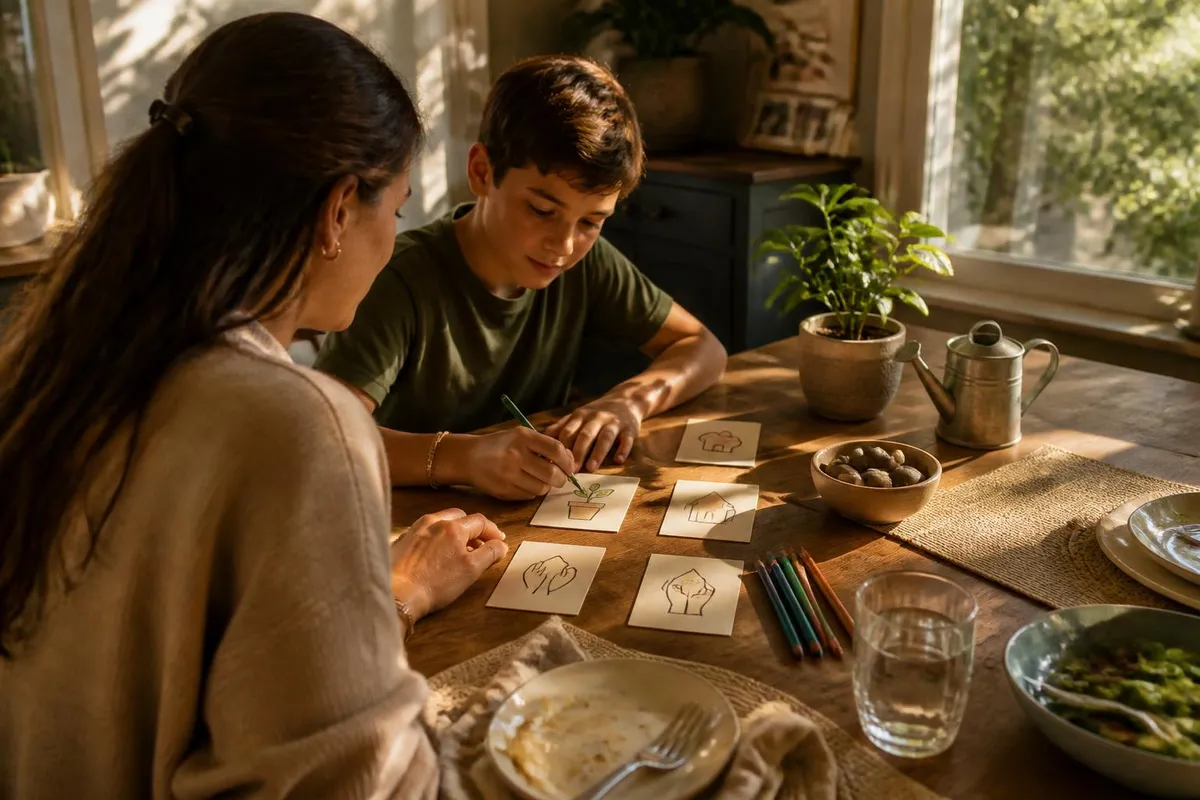
The dishes are mostly cleared. The evening has softened a little. Maybe one child is wiping the table, someone is reaching for pajamas, and you notice the houseplant by the window leaning in a way it did not lean yesterday.
Your child sees it too.
“I forgot again,” they say, looking at the small watering can sitting across the room.
And in that tiny moment, you can feel the familiar pull. You want to teach. You want your child to understand that responsibility matters. You may even hear the words forming: “This is why you need to be more responsible.”
That response makes sense. You are not wrong for wanting your child to learn responsibility. But here is the quiet question underneath the moment:
Does your child know what responsibility actually looks like right now?
How Children Understand Family Values at Home
Family values can sound beautiful when we say them out loud.
“We value responsibility.”
“We are kind.”
“We help each other.”
“We tell the truth.”
“We don’t give up.”
But children do not come to understand values mainly because we announce them, print them, frame them, or repeat them with frustration when they forget.
Children learn family values through repeated experiences.
They learn from the way we speak when something goes wrong. They learn from what happens after a mistake. They learn from the routines we return to, the expectations we hold, the way we repair, and the opportunities they are given to contribute in real life.
That is why creating an intentional family culture is not only about deciding what your family believes. It is about translating those beliefs into something your child can see, hear, practice, and experience over and over again.
Not perfectly.
Repeatedly.
The Real Problem Beneath the Moment
When a child forgets to water the plant, it is easy for the moment to become about character.
“You’re being lazy.”
“You never remember.”
“You need to care about something besides yourself.”
Most parents do not say these things because they want to shame their child. They say them because they are tired, frustrated, and trying to communicate, “This matters.”
But a child may hear the word responsibility and still not know what to do with it.
To them, responsibility might start to mean:
- “Don’t disappoint my parent.”
- “Remember everything without help.”
- “If I forget, I’m bad.”
- “Responsibility is something adults talk about when they are upset.”
That is not the same as understanding the value.
A value becomes understandable when it is attached to a lived pattern. The child needs to experience responsibility as a meaningful action, not just a label.
In the plant moment, responsibility is not abstract. It is visible.
The plant is drooping.
The watering can is nearby.
The child forgot.
Something that belongs to the family needs care.
That is the teaching moment.
A Family Value Is More Than a Word
A posted list of family values can be lovely. A family meeting can be meaningful. A phrase you repeat often can help your child internalize language.
But words alone are not the full lesson.
If we say, “We value warmth,” but the home feels unpredictable and sharp most of the time, the child learns the pattern more than the slogan.
If we say, “We value contribution,” but children are rarely invited to participate in real household care, the value stays theoretical.
If we say, “We value perseverance,” but mistakes are met with panic or criticism, the child may learn to avoid difficulty rather than move through it.
This does not mean your home has to be calm, organized, and beautifully regulated all the time. A safe and warm home is not a perfect home.
A safe and warm home is created through responsive language, predictable expectations, shared contribution, and repair.
That is what makes the home environment meaningful for child development. Children are learning from the emotional climate and the repeated rhythms around them. They are learning what happens when someone forgets, when someone helps, when someone gets corrected, and when someone tries again.
Why “Be Responsible” Often Misses the Lesson
Let’s go back to the plant.
Your child says, “I forgot again.”
The common response might be:
“You need to be more responsible. I already reminded you. If you can’t even remember to water a plant, how are you going to handle bigger responsibilities?”
Again, this usually comes from a good desire. You want your child to connect this small responsibility to larger maturity.
But in the moment, the child may not hear a pathway. They may hear a verdict.
They may feel embarrassed, defensive, discouraged, or confused. They may focus on your disappointment instead of the plant’s need.
A lecture may create immediate compliance. It may even get the plant watered that night.
But it does not necessarily teach meaning, skill, ownership, or repair.
A child learns responsibility more deeply when the parent slows the moment enough to translate the value:
- What happened?
- Why does it matter?
- What is expected now?
- What can we do next time?
That is where connection and accountability belong together.
The Practical Shift: Make the Value Concrete
When you are trying to teach a family value in everyday life, try this four-part sequence:
- Connect with the child’s experience.
- Name the value in concrete language.
- Hold a clear and appropriate expectation.
- Invite one specific next step.
This is simple enough to remember when you are tired, but strong enough to shape the culture of your home over time.
1. Connect With the Child’s Experience
Connection does not mean you ignore the forgotten task.
It means you begin by seeing the child in front of you before you correct the behavior.
In the plant moment, that might sound like:
“You noticed it’s drooping. That doesn’t feel good when you realize you forgot.”
Or:
“You forgot, and we can still make a plan to care for it now.”
This helps the child stay present instead of disappearing into shame or defensiveness.
You are not saying, “It’s fine that you forgot.” You are saying, “You are still connected to me while we deal with what happened.”
That distinction matters.
2. Name the Value in Concrete Language
Children need values translated into everyday words.
Instead of only saying, “Be responsible,” you might say:
“Responsibility means taking care of something that belongs to all of us.”
Or:
“In our family, contribution means we each help care for the home in small ways.”
Now the value has a picture attached to it.
Responsibility is not just an adult word. It is a child carrying the watering can. It is noticing the plant. It is returning to a task even after forgetting. It is helping care for something shared.
For a younger child, you might keep it even simpler:
“This plant is part of our home. We help take care of it.”
For an older child, you might add:
“Part of responsibility is noticing when a system is not working and adjusting it.”
The wording can grow with the child, but the value stays visible.
3. Hold a Clear and Appropriate Expectation
Warmth does not remove accountability.
Understanding that your child forgot does not mean the plant no longer needs water. Compassion does not cancel contribution.
You might say:
“I understand that you forgot. The plant still needs care, and you still need to help.”
That sentence holds both truths.
Your child is not bad for forgetting.
Your child is still responsible to participate.
Depending on the child’s age, temperament, and ability, help may look different. A younger child may need you to walk with them, fill the small watering can together, and pour slowly. An older child may be able to water the plant independently and help create a reminder for the next day.
The expectation should be clear, but not crushing.
The goal is not to make the child feel ashamed enough to remember next time. The goal is to help the child practice returning to responsibility.
4. Invite One Specific Next Step
Abstract correction overwhelms children. Specific action helps them move.
Instead of:
“You need to do better.”
Try:
“Let’s water it now, and then we’ll put the watering can beside the plant so it’s easier to remember tomorrow.”
Or:
“After dinner, when we wipe the table, you’ll check the plant before you leave the kitchen.”
Or:
“Let’s draw a little plant picture and put it near your evening routine chart.”
One step.
Not a complete life overhaul. Not a long speech about maturity. Just one doable action that connects the value to practice.
This is how family routines begin to carry family values.
Make Family Values Visible in the Home Environment
Sometimes children forget because they are careless.
But very often, children forget because the environment is not helping the value become visible.
If the watering can is tucked in a closet, the plant is behind a curtain, and the task happens at a different time every day, the child is relying almost entirely on memory. That may not be realistic, especially for younger children.
Environmental design is not a substitute for relationship or accountability, but it can support both.
For the plant, you might:
- Place the small watering can beside the plant.
- Use a picture cue for a younger child.
- Add “check the plant” to an existing evening rhythm.
- Let an older child design the reminder system.
- Choose one predictable time, such as after dinner cleanup.
The cue matters because it turns the value into something the child can see.
The routine matters because predictable routines reduce the number of decisions a child has to make. The task becomes part of the rhythm of home rather than a random instruction that appears only when an adult remembers to give it.
This is not about creating a rigid productivity system for your family. It is about making it easier for your child to practice what you say matters.
Connection and Accountability Belong Together
Some parents worry that if they respond with warmth, they are being permissive.
But connection is not permissiveness.
You can be kind and still hold the line.
You can acknowledge forgetfulness and still expect participation.
You can say, “I know you didn’t mean to forget,” and also say, “Let’s take care of it now.”
A connected response may actually make accountability easier for a child to receive because they are not using all their energy to protect themselves from shame.
This also gives you room to model the value yourself.
Maybe the next week, you forget to move the watering can back. Or you get sharp and say, “How many times do I have to remind you?” before you catch yourself.
Repair is part of the culture too.
You might say:
“I got sharper than I wanted to. I’m sorry. Responsibility in our family also means coming back and making repairs when we miss it. Let’s reset and figure out what needs to happen with the plant.”
That moment does not weaken your authority.
It makes the value more believable.
Your child sees that responsibility is not only something children owe adults. It is something everyone in the family practices.
What Research Tells Us About the Home Environment and Child Development
Research on the home environment and child development consistently points toward the importance of repeated experiences, not just the physical appearance of the home.
For example, research on home routines, safety, and children’s development supports the idea that children’s environments include caregiver warmth, monitoring, language-rich interaction, and repeated routines. In other words, the emotional and relational patterns of home matter.
Similarly, research connected to the home environment, including the HOME-21 study, reminds us that physical organization, caregiver responsiveness, and opportunities for language and play are all part of a supportive environment.
That does not mean your house needs to be spotless. It does not mean one plant routine guarantees a particular outcome.
It means ordinary moments can become meaningful when they include responsiveness, participation, and practice.
A recent systematic review on routines and child development also reinforces what many parents sense intuitively: predictable daily rhythms can support children’s growing skills. Not because routines magically create character, but because repetition gives children another chance to practice.
That is the heart of this lesson.
Values become understandable when they are repeated in the real life of the home.
Choose One Value, Not All of Them
There are many beautiful values you may want your family to live out:
Safety.
Warmth.
Curiosity.
Perseverance.
Generosity.
Play.
Spiritual grounding.
Responsibility.
Contribution.
But trying to teach all of them at once can leave everyone overwhelmed.
Instead, ask yourself:
What is one value that would most help our home feel more like the culture I hope we are building?
Maybe you want your home to feel warmer one year from now.
Maybe you want your children to experience more shared contribution.
Maybe you want mistakes to feel more repairable.
Maybe you want responsibility to feel less like nagging and more like belonging.
You do not have to redesign your whole family this week. Choose one value and translate it into one repeatable practice.
That is intentional family culture in motion.
Not as a poster.
As a pattern.
A Question Worth Asking Yourself
Pause for a moment and picture your home as it often feels today.
Not the ideal version. Not the worst moment. Just the honest pattern.
Then picture what you hope your child experiences one year from now.
What do you hope they feel when they make a mistake?
What do you hope they understand about being part of the family?
What do you hope they see you do when you forget, repair, or try again?
Now narrow it down.
What is one value that would help close the gap between the culture you have and the culture you hope to create?
Your Small Step Today
For the next several days, try this simple experiment.
1. Choose one value
Pick only one.
For example: responsibility.
2. Write a child-friendly meaning
Keep it concrete.
“Responsibility means taking care of something that belongs to all of us.”
Or:
“Contribution means everyone helps care for our home in small ways.”
3. Choose one recurring moment
Use a moment that already exists.
After dinner.
Before pajamas.
When the table is wiped.
When the lights are turned down for the evening.
Attach the value to something predictable.
4. Use the four-part sequence
When the moment comes, practice:
- Connect: “You noticed the plant is drooping. It doesn’t feel good to realize you forgot.”
- Name: “Responsibility means taking care of something that belongs to all of us.”
- Expect: “The plant still needs care, and you need to help.”
- Next step: “Let’s water it now and put the watering can beside the plant for tomorrow.”
5. Add one visible cue
Put the watering can where the plant is visible.
Draw a simple picture reminder.
Let an older child help design the system.
Keep it small enough that you will actually use it.
Then observe.
Does your child begin to notice sooner?
Does the conversation become less tense?
Does the value feel more concrete?
Does the routine reveal where more support is needed?
You are not looking for perfection. You are looking for what becomes easier, clearer, or more visible.
Keep Growing
Your child will not understand your family values because you say them once with the perfect words.
They will understand them because those values become part of the way your home works.
A plant gets watered.
A mistake gets repaired.
A child contributes.
A parent stays warm and still follows through.
A forgotten responsibility becomes a chance to practice, not a declaration of character.
This is how values move from slogans into lived experience.
Small moments, repeated with intention, can quietly shape the culture of your home. And when you miss it, you can return. That return is part of the lesson too.