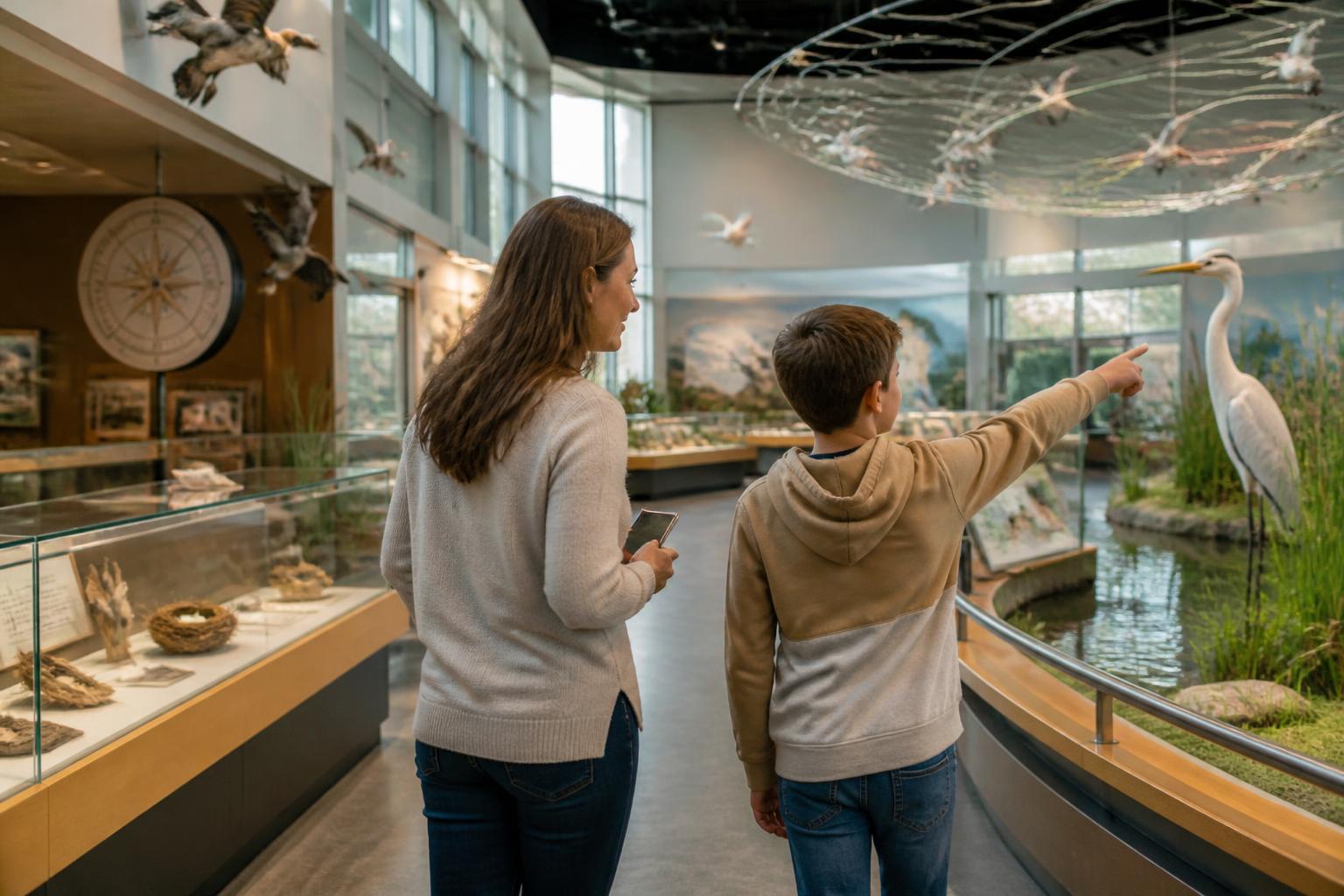
The car is quiet for half a block after pickup, the kind of quiet that comes after a long school day and before everyone fully lands at home. You are thinking about dinner, the message you forgot to answer, and whether you have enough energy for the rest of the evening.
Then your child points out the window and says, “Why is that big white bird standing by the water? Does it live there? How does it know where to go when it flies away?”
You glance over, see the bird near the edge of a drainage pond, and realize you have absolutely no idea. Not the bird’s name. Not where it goes. Not whether it migrates. And before you can even gather a response, your child keeps thinking out loud: “Maybe it’s waiting for fish. Do birds remember places? How do they know which way is north?”
There is a very human temptation in that moment to shut it down.
“I don’t know.”
Or, “Ask me later.”
Or, “I’m driving. Let’s not get into that right now.”
And sometimes those words come out because you are tired, not because you do not care. But there is a small shift that can change the entire message your child receives.
Not from, “I don’t know, stop asking.”
But from, “I don’t know. Let’s find out.”
When Childhood Curiosity Meets “I Don’t Know”
One of the most powerful parenting responses is also one of the simplest:
“I don’t know, let’s find out.”
It may not sound impressive. It may not feel like a strategy. It may even feel, at first, like admitting defeat.
But when your child asks a question you cannot answer, your response teaches more than the answer ever could. It teaches your child what to do with uncertainty. It teaches whether questions are welcome. It teaches whether adults have to perform constant certainty, or whether learning can be something safe, honest, and shared.
This is especially important for childhood curiosity. Children do not only learn from facts we give them. They learn from the atmosphere around their questions.
When you respond with warmth and honesty, you are saying:
“Your question matters, and we can approach uncertainty together.”
That is not permissive parenting. That is not turning your home into a classroom. That is not promising to research every passing thought.
It is simply becoming a steady guide in a moment when neither of you has the answer yet.
The Real Problem Is the Pressure to Know Everything
Many parents feel embarrassed when they cannot answer a child’s question.
Your child asks, “How do birds know where to migrate?” or “Why did the sky look orange today?” or “How does a bridge stay up?” and somewhere inside, you feel pressure.
Shouldn’t I know this?
Should I make something up?
Will my child think I’m not smart?
Am I supposed to stop everything and research this right now?
Then real life adds another layer. You may be driving. You may have another child talking over the question. You may be hungry, overstimulated, late, or mentally done for the day.
So the issue is not simply, “My child asked a hard question.”
The real issue is what happens inside the parent when the question arrives at an inconvenient time.
A child’s curiosity often shows up when we do not have the time, energy, or information to meet it fully. That does not make you a bad parent. It means you are human.
The goal is not to become an encyclopedia.
The goal is to avoid accidentally teaching your child that curiosity is annoying, inconvenient, or something they should keep to themselves.
There is a big difference between honest uncertainty and abandoning the question.
Honest uncertainty sounds like:
“I’m not sure. That is a good question.”
Abandoning the question sounds like:
“I don’t know,” in a tone that closes the door.
The same words can carry very different messages.
Why “I Don’t Know” Can Be Powerful
“I don’t know” becomes powerful when it is paired with openness.
It models humility. You are showing your child that adults do not have to pretend.
It models lifelong learning. You are showing that not knowing is not the end of the road.
It models calm problem-solving. You are showing that uncertainty does not have to create panic, shame, or avoidance.
And it models relationship. You are communicating, “I may not have the answer, but I am still with you in the question.”
That matters.
A child who asks questions is not only asking for information. Often, they are also inviting you into their thinking. They are showing you what caught their attention. They are giving you a glimpse into how their mind is working.
When you meet that moment with interest, you help your child feel seen.
Not because you answered perfectly.
Because you noticed.
What to Say When Your Child Asks a Question You Cannot Answer
When your child asks a question you cannot answer, try this simple sequence:
- Affirm the question.
- Admit what you do not know.
- Choose a manageable way to explore.
- Return to it later.
That’s it.
You do not have to do it perfectly. You do not have to use fancy language. You do not have to research for an hour.
Let’s go back to the car ride.
Your child sees the bird by the water and starts wondering where it lives and how it knows where to fly.
1. Affirm the Question
Start by letting your child know their thinking matters.
You might say:
- “That is an interesting question.”
- “I like how you noticed that.”
- “You’re really thinking about how that bird lives.”
- “That’s a question worth coming back to.”
This does not mean you are agreeing to stop everything. It simply opens the door instead of closing it.
Affirming the question tells your child, “Your mind is welcome here.”
2. Admit What You Do Not Know
Next, be honest.
You might say:
- “I’m not sure what kind of bird that is.”
- “I don’t know how birds know where to migrate.”
- “I’ve wondered about that too.”
- “I don’t want to guess and tell you the wrong thing.”
This is where many parents hesitate. We sometimes think authority means always knowing.
But healthy authority is not the same as pretending.
You are still the parent. You are still the guide. You are still responsible for safety, limits, and direction. Saying “I don’t know” does not remove your leadership.
It makes your leadership more trustworthy.
3. Choose a Manageable Way to Explore
Now choose one realistic next step.
Not five. Not a full lesson. Not a project that takes over the evening.
One possible next step.
If you are driving, you might say:
- “We can’t look that up while I’m driving, but I can add it to a note when we park.”
- “Let’s remember: white bird by the pond. After dinner, we can see if we can identify it.”
- “I’m not able to investigate right now, but I don’t want to lose the question.”
If you are home and have a few minutes, you might say:
- “Let’s look in that bird book for five minutes.”
- “Let’s search for a short video about bird migration.”
- “Let’s write down what we noticed before we look it up.”
- “Let’s ask Grandpa when we see him. He knows a lot about birds.”
If it is not a good time, you are allowed to set a boundary:
- “I want to come back to that, but right now we need to get dinner started.”
- “That’s a great question. I don’t have the energy to research it tonight, so let’s put it in our question note.”
- “We are not using screens right now, but we can look for a library book this weekend.”
This is the balance.
You honor the question without surrendering the whole routine.
Connection does not mean every question becomes urgent.
4. Return or Reflect Later
The follow-through does not need to be dramatic.
After dinner, you might say, “Remember the bird by the pond? Do you still want to see if we can figure out what it was?”
Maybe your child says yes. You look at a few pictures together and discover it may have been an egret or heron.
Maybe your child has already moved on. That is okay too.
You can still say, “I wrote it down because I liked your question. We can come back to it another day if you want.”
The return communicates something important: “I remembered what mattered to you.”
That is relationship-building.
When You Do Not Have Time Right Now
Parents often worry that encouraging questions means they will be pulled into nonstop research.
You do not have to answer every follow-up.
You do not have to investigate immediately.
You do not have to turn home into school.
You can be warm and still protect the rhythm of your family.
Try phrases like:
- “I can answer one more question, and then I need to focus on driving.”
- “Let’s save the rest for later because my brain is tired right now.”
- “That question deserves more attention than I can give it in this moment.”
- “I love your curiosity. I also need us to move into dinner now.”
- “Let’s put it in our question list so we don’t forget.”
This matters because boundaries help curiosity survive real life.
If every question requires an immediate deep dive, parents burn out. If every question is dismissed, children may stop offering them. The middle path is to welcome the question and choose a doable next step.
That is sustainable.
Small Ways to Support Curiosity-Driven Learning at Home
Curiosity-driven learning at home does not need to look like a formal lesson plan. It can be ordinary, brief, and woven into family life.
For the bird question, you might choose one of these:
- Add the question to a phone note called “Things We Wonder.”
- Look through a library book about local birds.
- Watch a short, trustworthy documentary segment about migration.
- Observe the pond again later in the week.
- Visit a nature center or museum when it already fits your schedule.
- Ask someone who knows more about birds, animals, or outdoor life.
- Try a simple related experiment, like using a compass to talk about direction.
The key is to choose one small doorway.
If your child loses interest, you have not failed. Curiosity often comes in waves. Sometimes the value was in honoring the question, not completing the investigation.
If you forget, repair lightly:
“I forgot to look up the bird with you last night. I’m writing it down now so we can come back to it.”
That sentence teaches responsibility without shame.
Your child learns that forgetting is not the same as not caring, and that we can return to what matters.
What the Research Tells Us
Research does not tell us that one perfect phrase will determine a child’s future. Parenting is not that fragile.
But research does support something very practical: curiosity grows in environments where children are invited to ask, explore, and stay engaged with new information.
A 2024 review in Nature Reviews Psychology on curiosity in children across ages and contexts describes curiosity as connected to learning across different ages and settings, and highlights the importance of environments that make room for questions and exploration.
That does not mean parents need to create constant enrichment.
It means the tone around questions matters.
Another review on play, curiosity, and cognition connects curiosity and play with exploration, persistence, and learning. In parent language, this means children often learn deeply through ordinary experiences: noticing, wondering, testing, building, watching, collecting, pretending, comparing, and asking again.
A book, a walk by the pond, a hobby, a simple experiment, a museum visit when it fits, or a thoughtful conversation can all become part of fostering curiosity.
Not because you forced learning.
Because you made space for it.
Notice the Pattern, But Do Not Turn It Into a Label
Here is where this practice becomes even more meaningful.
One question about a bird may simply be one question about a bird.
But over time, you may notice patterns.
Maybe your child often asks about animals, weather, machines, maps, sounds, stories, numbers, building, cooking, fairness, people’s feelings, or how things work.
Maybe they notice tiny details other people miss.
Maybe they keep returning to the same subject.
Maybe they like explaining what they learned.
Maybe they collect facts, draw pictures, build models, act things out, or ask follow-up questions days later.
These patterns can be clues.
Not conclusions.
There is a difference between noticing and labeling.
Noticing sounds like:
- “You’ve been really interested in birds lately.”
- “I notice you ask a lot of questions about how things move.”
- “You seem to enjoy figuring out how things work.”
- “You came back to that question again. It must have really stayed with you.”
Labeling too quickly sounds like:
- “You’re going to be a scientist.”
- “You’re our nature kid.”
- “This is obviously your thing.”
- “You’re not like your brother. He never cared about this.”
The first approach gives your child room to explore.
The second can create pressure, comparison, or a fixed identity.
At Raising Royalty, we want to notice and nurture strengths without controlling a child’s future. Our children are not projects to brand. They are people to know.
So when a repeated interest appears, follow it gently.
Offer a book. Take the walk. Save the question. Visit the museum when it fits. Let them tell you what they noticed.
And allow the interest to grow, fade, return, or transform.
That is how we support intrinsic motivation to learn without turning curiosity into performance.
A Question Worth Asking Yourself
The next time your child asks something you cannot answer, pause and ask:
“Am I responding to the question, or am I responding to my own discomfort with not knowing?”
That pause can soften the moment.
Maybe you are tired. Maybe you are embarrassed. Maybe you feel rushed. Maybe you truly cannot engage right now.
You can still choose a response that keeps the relationship open.
“I don’t know, and I want to come back to that.”
Those words are enough for many moments.
Your Small Step Today
For the next three to five days, try this small curiosity practice:
- Welcome one question your child asks.
- Use the phrase, “I don’t know, let’s find out,” or your own version of it.
- Record one unanswered question in your phone or on paper.
- Investigate it in one small way.
- Notice whether your child returns to that subject, asks a related question, or moves on.
Keep it simple.
You are not building a curriculum. You are building a habit of shared attention.
If the question comes while you are driving, set the boundary.
“We can’t look that up right now, but I want to remember it.”
If the question comes when you are exhausted, be honest.
“I like that question. I don’t have the energy to explore it tonight, but let’s save it.”
If you forget, repair.
“I wanted to come back to that and forgot. Let’s write it down now.”
This is progress, not perfection.
Keep Growing
This week’s Raising Royalty focus on Exploration and Curiosity is not about raising children who know everything. It is about raising children who feel safe enough to wonder, brave enough to ask, and supported enough to keep learning.
You do not need every answer to be a strong parent.
You do not need to perform expertise to be a trusted guide.
Sometimes the most powerful thing you can say is:
“I don’t know.”
And then, with warmth and steadiness:
“Let’s find out.”